Why Australia Is Reforming Good Character References in Sexual Violence Cases
Across the world, criminal justice systems are built on the principle that sentencing should reflect the full picture of an offender — not just the crime, but the person. But what happens when that principle is weaponised? In Australia, character references submitted by employers, community leaders and family members have long allowed a perpetrator's reputation to influence their sentence, sometimes at the direct expense of victim-survivors. A landmark nation campaign for legislative reform is now challenging that.
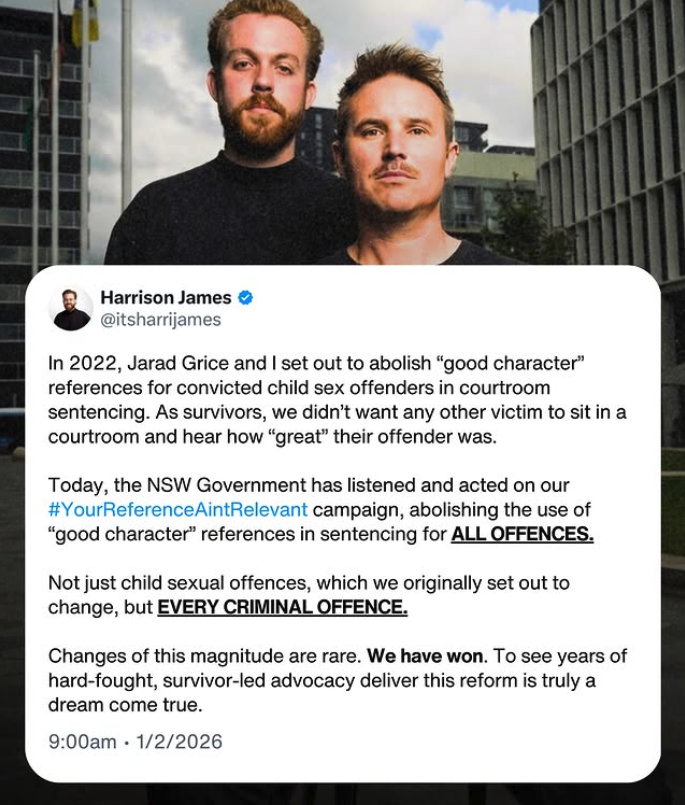
#YourReferenceAintRelevant
Led by survivor-advocates Harrison James and Jarad Grice, the #YourReferenceAintRelevant campaign is calling for an end to the use of "good character" as a mitigating factor in sentencing for sexual offences. Both survivors of child sexual abuse themselves, both argue that "good character" is a deeply subjective concept that is too often used to minimise the violence committed and the lifelong impact experienced by victim-survivors.
After four years of relentless campaigning by survivor-advocates Harrison James and Jarad Grice, in May the NSW Government moved to abolish "good character" references for perpetrators of sexual violence, becoming the first jurisdiction in Australia to do so.
The impact of their advocacy is now reaching beyond New South Wales. The campaign has sparked a national movement for reform, with jurisdictions across Australia reviewing the role of good character evidence in sentencing. Similar legislative changes are now being considered in South Australia, Victoria, Tasmania and Western Australia, while the ACT has also committed to reform in this area.
So what exactly are character references and why do they matter?
A character reference is a letter written by someone who can speak to an alleged offender's conduct and personal qualities. Typically, such reference would outline the good nature of the accused, their personal attributes, contributions to the community and the why, what and how of their offending. Letters are submitted to the court during the sentencing process in an effort to potentially minimise or suspend their sentence.
One of the most well-known examples came from former Prime Minister John Howard, who infamously wrote a character reference for convicted child sex offender George Pell. In 2019, Howard said he had known Pell for around 30 years and that despite the charges against him, "None of these matters alter my opinion of the Cardinal.”
While writing this blog I couldn’t help but reflect on my own experience of ‘good character’ and the power of social capital in denouncing experiences of harm. I grew up in a small beach town on the NSW far north coast — recently scrutinised for its predatory culture of rape. As a teenager, many of my sexual experiences existed somewhere between coercion and outright assault.
I was told, “If you don’t do this, we can’t see each other anymore”.
I was forced, “Come on, it will be fun, you’ll like it”.
I was manipulated, “She did it, why won’t you?”.
At the time, these experiences felt normal. It wasn't until years later, as more young people began sharing their own stories of non-consensual sex and conversations around consent became more public, that I started to recognise what had happened. When I began discussing my experiences, a wall of informal character references sprang up around the men responsible, shielding them from scrutiny.
"No way, he wouldn’t do that."
"He wasn't well in the head."
"He's really not a bad guy."
Spoken casually, almost reflexively, as if loyalty equated to the truth. These were their seals of approval, held together by the same social capital that bound them and shielded them. Small, repeated acts of protection that made accountability feel not just unlikely, but socially impossible. Their own unofficial ‘good character’ references, if you will.
Reputation as a Defence
What strikes me about this dynamic is how rarely it stays informal. We have watched, again and again, the machinery of social capital mobilise around powerful men the moment they are accused. When Harvey Weinstein's decades of predation finally broke into public consciousness in 2017, the initial response from many inside Hollywood wasn't horror, it was disbelief. Colleagues who had worked alongside him for years spoke of a man who was difficult, sure, but brilliant. A force of nature. The implication being that genius, in some quarters, functions as its own kind of character reference. The same logic protected Bill Cosby for the better part of five decades. America's dad. A man who had built an entire public identity on warmth and moral authority, and weaponised that identity so effectively that those who came forward were disbelieved not because their stories were implausible, but because his reputation felt more real than their testimony.
Australia has its own versions of this story. When allegations emerged against figures such as George Pell, Alan Jones, Jarryd Hayne or more recently men embedded in local political and community networks, public discussion often turned first to their standing, their achievements, their service and the people willing to vouch for them. The question was not simply whether the allegations were true, but how they could possibly be true of someone so respected. Reputation became evidence. Familiarity became a defence.
What this tells us is that the formal character reference submitted to a court does not exist in isolation. It is the written codification of something that has already been happening socially for months, sometimes years. By the time a judge reads that a perpetrator is a loving father, a committed community member, a man of faith — the community has often already decided the same. The reference doesn't create the bias. It just makes it official.
More Than a Legal Reform
James and Grice’s tireless campaigning was simple, it named the system. Not just the courtroom mechanisms, but the entire social architecture that makes character references possible. #YourReferenceAintRelevant didn’t just push for legislative reform but gave language to something victim-survivors have always known but rarely seen acknowledged. That the weight of a community’s esteem can, in practice, function as a second sentence handed to the person harmed, not the person who caused it. This campaign asks us to sit with a deeply uncomfortable truth: that being well-regarded and being safe to be around are not the same thing and that our legal system had, for too long, confused one for the other. NSW's decision to abolish good character references in sexual violence sentencing is not the end of that confusion — but it is the first formal admission that the confusion existed. And that, in no small part, is because two survivors refused to let it go unnamed.
Beyond Character References
But abolishing character references is one thread pulled from a much larger knot. Australia's legal system was not designed with victim-survivors of sexual violence in mind. From the way evidence is tested in court, to the attrition rates that see the vast majority of reports never reach a conviction, to the secondary trauma embedded in cross-examination, the reforms needed are systemic and long overdue. But NSW's decision offers something important: proof that survivor testimony can move institutions. That four years of relentless advocacy by two people who had every reason to stay silent can change the law. If one campaign can do that, the question is no longer whether the system can change, rather how much further we can push it.